
What’s New
Manual Quick Lock vs. Conventional CNC Workholding: When Is It Worth the Upgrade?
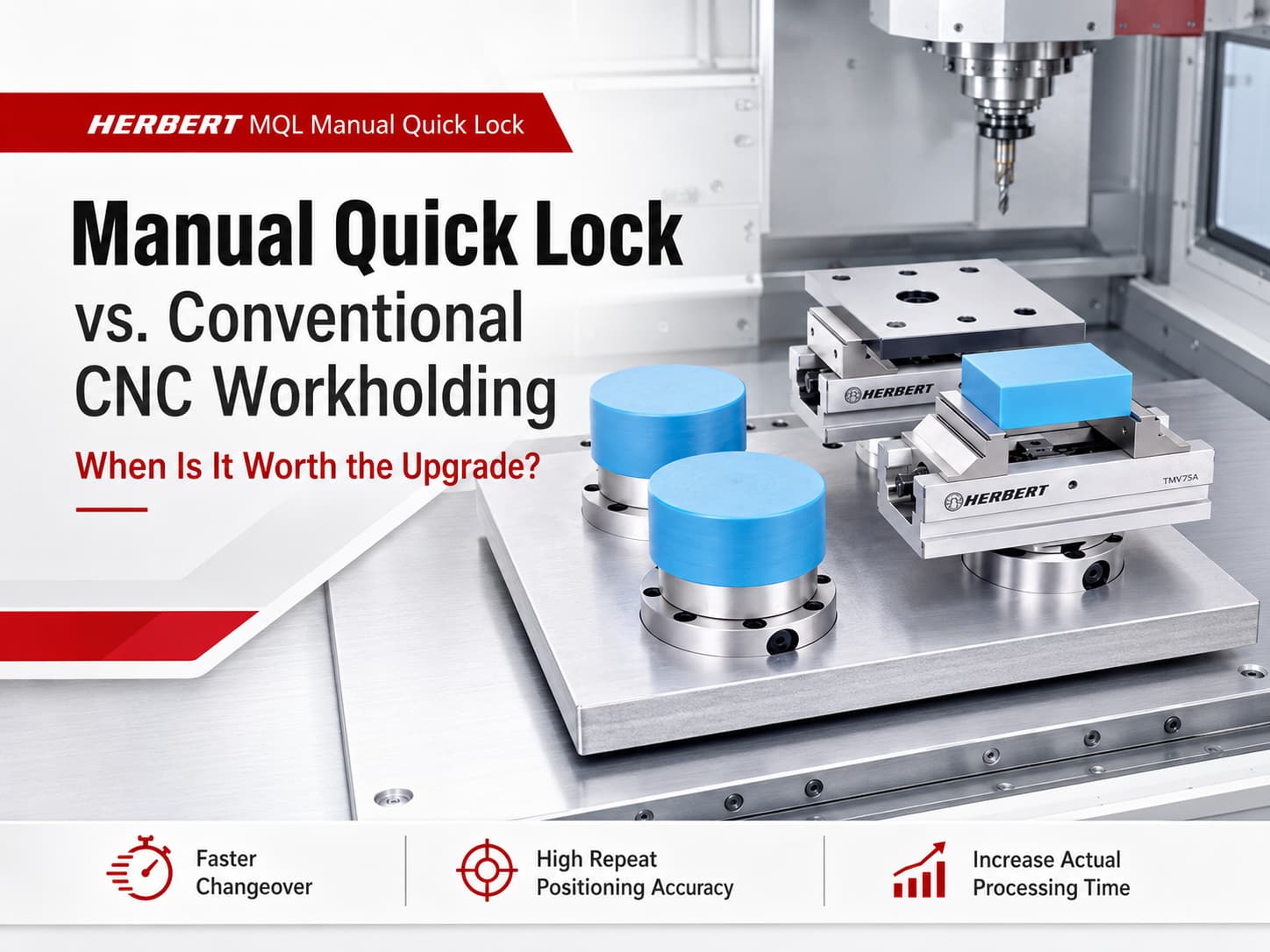
In CNC machining, faster cutting does not always mean higher productivity. If operators spend too much time replacing workpieces, changing fixtures, or repeating setup procedures, valuable machine capacity is still being lost.
HERBERT provides CNC workholding solutions designed to improve machining efficiency, including machine vises, self-centering vises, zero point systems, quick change systems, and the MQL Manual Quick Lock.
The HERBERT MQL Manual Quick Lock is designed to shorten the replacement time of workpieces or fixtures, increase actual machine processing time, and provide high repeat positioning accuracy. For CNC manufacturers that frequently change setups but do not require a fully automated workholding system, it can offer a practical way to improve production efficiency.
What Is the HERBERT MQL Manual Quick Lock?
The MQL Manual Quick Lock is a manually operated quick-locking solution designed to make the replacement of workpieces or fixtures faster and more repeatable.
Instead of spending excessive time on repeated positioning and conventional fastening procedures, operators can use the MQL system as part of a faster workholding setup.
According to HERBERT, the three primary benefits of the MQL system are:
- Increasing actual machine processing time
- Shortening workpiece or fixture replacement time
- Providing high repeat positioning accuracy
Key Specifications of the HERBERT MQL Manual Quick Lock
HERBERT offers different MQL configurations to accommodate various workholding layouts and fixture sizes. Manufacturers can review the complete product information on the HERBERT MQL Manual Quick Lock product page.
Individual MQL Models
| Model | A (mm) | B (mm) | C (mm) |
|---|---|---|---|
| MQL-25 | 100 | 40 | 25 |
| MQL-35 | 148 | 50 | 35 |
| MQL-25A | 43 | 25 | 40 |
| MQL-35A | 53 | 35 | 50 |
MQL Base Plate Configurations
| Model | A (mm) | B (mm) | C (mm) | D (mm) | E (mm) | F (mm) | G (mm) |
|---|---|---|---|---|---|---|---|
| MQL-225-350 | 200 | 350 | 68 | 35 | 150 | 100 | 100 |
| MQL-225-400 | 200 | 400 | 68 | 35 | 200 | 100 | 100 |
| MQL-235-550 | 200 | 550 | 93 | 40 | 270 | 120 | 150 |
Additional multi-position configurations include HQ-400-MQL and HQ-500-MQL, providing further options for larger workholding arrangements.
These different sizes allow manufacturers to select an MQL configuration according to the fixture, vise, workpiece arrangement, and available machine table space.
Manual Quick Lock vs. Conventional CNC Workholding
Traditional CNC workholding methods such as machine vises, bolts, T-slot clamps, and fixture plates remain suitable for many machining operations. However, when workpieces or fixtures must be changed frequently, repeated loosening, positioning, alignment, and fastening can increase non-cutting time.
The main difference is therefore not simply how the workpiece is held, but how efficiently the workholding setup can be changed and repositioned.
| Comparison Factor | Conventional CNC Workholding | HERBERT MQL Manual Quick Lock |
|---|---|---|
| Setup method | Traditional manual fastening and positioning | Manual quick-locking system |
| Workpiece or fixture replacement | May require repeated fastening and positioning steps | Designed to shorten replacement time |
| Repeat positioning | Depends on the fixture and setup method | High repeat positioning accuracy |
| Machine utilization | More non-cutting time may be required for frequent changes | Designed to increase actual machine processing time |
| Best suited for | Stable setups with infrequent changes | Frequent workpiece or fixture changes |
| Operation | Manual | Manual |
For long production runs where the same fixture remains on the machine for extended periods, conventional workholding may still be perfectly adequate.
The MQL becomes more valuable when frequent changes begin consuming a meaningful portion of available CNC machine time. Manufacturers facing this problem can also read Reducing Downtime: A Manufacturer’s Guide to CNC Quick Change Systems to learn more about how workholding changeovers can affect machine utilization.
4 Signs That a Manual Quick Lock May Be Worth the Upgrade
1. You Frequently Change Workpieces or Fixtures
The more often operators change workpieces or fixtures, the more important setup efficiency becomes.
Even small amounts of time saved during each change can accumulate across multiple machines, shifts, and production days.
For CNC job shops and manufacturers handling multiple orders, shortening repeated replacement procedures can help keep machines cutting for a greater percentage of available production time.
2. You Handle High-Mix, Low-Volume Production
High-mix, low-volume manufacturers frequently switch between different components, small batches, prototypes, and repeat orders.
Under these conditions, production flexibility can be just as important as cutting speed.
The MQL Manual Quick Lock can be considered when the objective is to make workpiece or fixture changes faster without immediately adopting a more complex automated workholding system.
3. Too Much Machine Time Is Lost During Setup
An expensive CNC machining center creates value primarily when it is machining.
If a significant amount of time is spent repeatedly removing fixtures, repositioning components, and preparing the next setup, workholding can become a productivity bottleneck.
HERBERT specifically designed the MQL to increase actual processing time by shortening workpiece or fixture replacement time.
When the second number becomes too large, a faster workholding method may be worth evaluating.
4. Repeat Positioning Matters to Your Production
Faster changeover alone is not enough if every replacement requires lengthy repositioning or alignment.
One of the stated advantages of the HERBERT MQL is high repeat positioning accuracy, making it relevant for operations where workpieces or fixtures must be repeatedly removed and installed.
This can be especially useful for repeat jobs, multiple fixtures, or production environments where setups are regularly changed and reused.
When Conventional Workholding May Still Be Enough
A Manual Quick Lock is not automatically necessary for every CNC operation.
Conventional workholding may remain the better choice when:
- The same setup remains on the machine for a long time.
- Workpiece or fixture changes are infrequent.
- Machining cycles are very long compared with setup time.
- The existing workholding process is already efficient.
- Frequent repeat positioning is not required.
For example, saving a few minutes of setup time has relatively little impact when one large workpiece requires many hours of continuous machining.
The situation is very different for short-cycle components, small-batch orders, or production environments with repeated fixture changes. The key is to identify whether workholding changeover is actually limiting machine utilization.
How Does Manual Quick Lock Fit into Other CNC Workholding Systems?
Manufacturers may have several options for improving CNC workholding efficiency, ranging from a manually operated quick lock to broader quick change and zero point clamping systems.
A Manual Quick Lock focuses on speeding up manual workpiece or fixture changes. A Quick Change System provides a broader workholding solution for exchanging fixtures, pallets, or setups, while a Zero Point Clamping System focuses on precise and repeatable positioning.
For a more detailed comparison of these advanced workholding technologies, read Quick Change System vs. Zero Point Clamping System: What’s the Difference?.
The most advanced system is not automatically the best choice. The right solution depends on production volume, changeover frequency, workpiece requirements, machine configuration, budget, and future automation plans.
Which Manufacturers Can Benefit Most from the MQL Manual Quick Lock?
The HERBERT MQL may be particularly relevant for:
- CNC job shops processing many different orders.
- High-mix, low-volume manufacturers that frequently switch between small batches.
- Prototype machining companies requiring flexible setup changes.
- Repeat production where fixtures must be removed and reinstalled.
- Manufacturers with short machining cycles where setup time represents a larger percentage of total production time.
The right solution still depends on the machine, fixture, workpiece dimensions, available table space, changeover frequency, and production objectives.
HERBERT MQL Manual Quick Lock: Is It Right for Your CNC Setup?
The question is not whether conventional CNC workholding is outdated. Traditional vises and fixtures remain highly effective for many machining applications.
The HERBERT MQL Manual Quick Lock is designed to shorten replacement time, improve repeat positioning, and increase the amount of time a machine can spend on actual processing. Multiple MQL sizes and base plate configurations are available to support different workholding layouts.
For manufacturers experiencing frequent changeovers, high-mix production, or excessive non-cutting setup time, upgrading to a manual quick-locking solution may provide a practical next step toward more efficient CNC workholding.
Looking for a Faster CNC Workholding Solution?
Tell HERBERT about your machine configuration, fixture requirements, workpiece dimensions, and production needs. Our team can help you evaluate whether the MQL Manual Quick Lock is suitable for your application.
Contact Us