
What’s New
Why Self-Centering Vises Are Ideal for 5-Axis CNC Machines
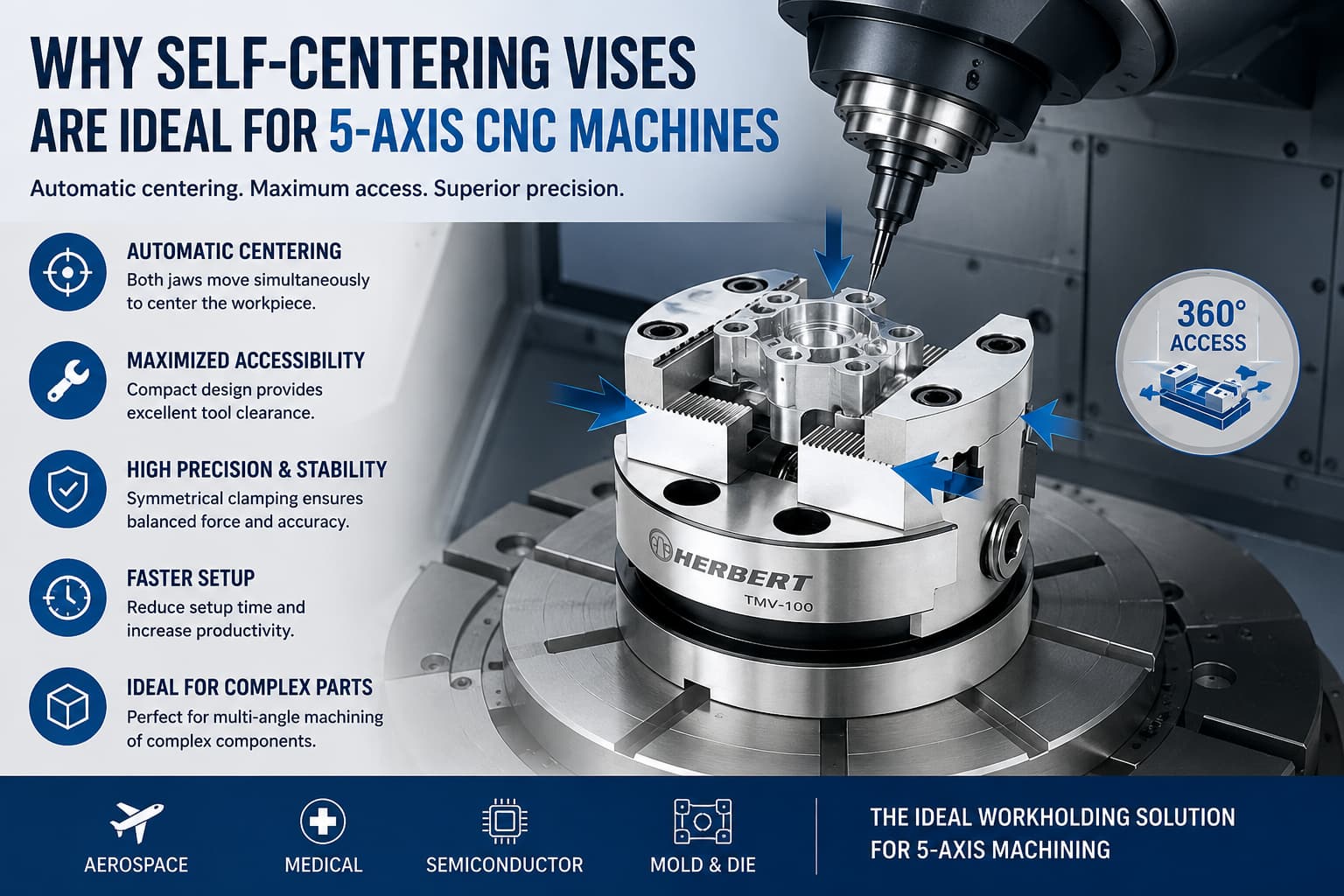
As manufacturers continue to adopt 5-axis CNC machining to produce increasingly complex and high-precision components, the importance of selecting the right workholding solution has never been greater. While machine capability, cutting tools, and programming often receive the most attention, the vise plays a critical role in determining machining accuracy, setup efficiency, and overall productivity.
Among the various workholding options available today, self-centering vises have become one of the most popular solutions for 5-axis machining applications. Their ability to automatically center workpieces, provide excellent accessibility, and maintain consistent clamping accuracy makes them particularly well-suited for the demands of modern multi-axis machining.
This article explores why self-centering vises are widely used on 5-axis CNC machines and how they help manufacturers improve both precision and efficiency.
Understanding the Challenges of 5-Axis Machining
Unlike traditional 3-axis machining, 5-axis CNC machines can approach a workpiece from multiple angles in a single setup. This capability allows manufacturers to:
- Machine complex geometries
- Reduce multiple setups
- Improve dimensional accuracy
- Shorten production lead times
- Increase overall machining efficiency
However, these advantages also create new workholding challenges.
The vise must:
- Hold the workpiece securely during multi-directional cutting
- Minimize interference with cutting tools
- Maintain positioning accuracy throughout the machining cycle
- Provide access to as many workpiece surfaces as possible
Traditional machine vises often struggle to meet these requirements because they may block tool access or require additional setup adjustments.
This is where self-centering vises offer significant advantages.
What Is a Self-Centering Vise?
A self-centering vise is a precision workholding device designed to move both jaws simultaneously toward the center of the vise.
Unlike conventional vises, where one jaw remains fixed and the other moves, a self-centering vise automatically positions the workpiece on the machine's centerline during clamping.
This design offers several important benefits:
- Automatic centering
- Improved repeatability
- Reduced setup time
- Better balance during machining
- Simplified fixture design
Because the workpiece is always positioned at the same center point, operators can achieve highly consistent setups with minimal adjustment.
Why Centering Matters in 5-Axis Machining
In 5-axis machining, machine movements are often programmed relative to a specific center position.
When a workpiece is not consistently centered, manufacturers may experience:
- Additional setup time
- Increased programming adjustments
- Positioning errors
- Reduced machining accuracy
A self-centering vise eliminates these issues by ensuring that every workpiece is automatically aligned to the same reference position.
This becomes especially valuable when machining multiple parts or switching between production batches.
By maintaining a consistent centerline, manufacturers can improve repeatability while reducing setup complexity.
Key Benefits of Using Self-Centering Vises on 5-Axis CNC Machines
While automatic centering is one of the defining features of a self-centering vise, the benefits extend far beyond positioning accuracy. In 5-axis machining environments, manufacturers must balance precision, tool accessibility, setup efficiency, and machining flexibility.
Self-centering vises are specifically designed to address these challenges. Their compact structure, symmetrical clamping mechanism, and repeatable positioning capabilities help manufacturers fully utilize the advantages of 5-axis CNC machines.
The following sections explore the key reasons why self-centering vises have become one of the most popular workholding solutions for modern 5-axis machining applications.
Maximizing Tool Accessibility
One of the biggest advantages of 5-axis machining is the ability to access multiple surfaces of a part without repositioning it.
However, this advantage can be limited if the vise blocks the cutting tool.
Self-centering vises are often designed with:
- Compact bodies
- Narrow jaw profiles
- Elevated clamping positions
These features provide greater clearance around the workpiece, allowing cutting tools to reach more surfaces during a single setup.
As a result, manufacturers can:
- Reduce secondary operations
- Minimize fixture changes
- Increase machining efficiency
- Improve surface quality
This improved accessibility is one of the primary reasons self-centering vises are commonly used on trunnion-style and rotary-table 5-axis machines.
Improved Accuracy Through Symmetrical Clamping
During machining, uneven clamping forces can introduce part distortion or positioning errors.
Traditional vises clamp from one side, which may create uneven force distribution depending on the workpiece geometry.
A self-centering vise applies force from both sides simultaneously.
Benefits include:
- Balanced clamping pressure
- Reduced workpiece deformation
- Improved dimensional accuracy
- Greater machining stability
This symmetrical clamping action is particularly important when machining precision aerospace, medical, and electronics components where tight tolerances are required.
In many 5-axis applications, even small positioning deviations can affect the final quality of complex parts. By applying equal force from both sides, self-centering vises help maintain workpiece stability throughout the entire machining process.
Faster Setup and Higher Productivity
Setup time is one of the largest contributors to non-cutting machine downtime.
With conventional vises, operators may need to:
- Manually align workpieces
- Verify center positions
- Adjust offsets
A self-centering vise simplifies this process.
Because the workpiece automatically aligns to the vise centerline, operators can achieve consistent positioning with minimal effort.
This leads to:
- Shorter setup times
- Faster part changeovers
- Reduced operator dependency
- Increased machine utilization
For manufacturers producing small batches or high-mix products, these productivity gains can be substantial.
When setup procedures become simpler and more repeatable, manufacturers can reduce production bottlenecks and maximize the value of their 5-axis machining investments.
Ideal for Complex and High-Value Components
Many industries rely on 5-axis machining because their parts contain complex geometries that would be difficult or impossible to manufacture using conventional methods.
Examples include:
Aerospace Components
- Structural brackets
- Turbine components
- Aircraft fittings
Medical Devices
- Orthopedic implants
- Surgical instruments
- Medical housings
Semiconductor Equipment Parts
- Precision mounting structures
- Vacuum components
- High-accuracy assemblies
Mold and Die Components
- Core inserts
- Mold cavities
- Complex contour surfaces
These parts often require machining from multiple directions while maintaining strict dimensional accuracy.
A self-centering vise helps ensure that the workpiece remains precisely positioned throughout the process, allowing manufacturers to achieve consistent quality even on highly complex parts.
Combining Self-Centering Vises with Quick Change Systems
Many advanced manufacturers combine self-centering vises with:
- Quick Change Systems
- Zero Point Clamping Systems
- Palletized workholding solutions
This combination creates a highly flexible machining environment.
Benefits include:
- Faster fixture changes
- Repeatable positioning
- Reduced machine downtime
- Greater automation readiness
By integrating these technologies, manufacturers can maximize the performance of their 5-axis CNC machines while maintaining high levels of accuracy and efficiency.
For high-mix, low-volume production environments, combining self-centering vises with quick change systems can dramatically reduce setup time while ensuring every workpiece is positioned accurately and consistently.
The Herbert Solution
At Herbert Enterprise Co., Ltd., we understand the unique workholding challenges associated with 5-axis machining.
Our self-centering vise solutions are designed to provide:
- High positioning accuracy
- Symmetrical clamping force
- Excellent tool accessibility
- Reliable repeatability
- Compatibility with modern CNC machining environments
Whether machining aerospace components, medical parts, precision molds, or high-value industrial components, Herbert's self-centering vises help manufacturers achieve stable and efficient machining performance.
In addition, Herbert's workholding solutions can be integrated with Quick Change Systems and Zero Point Clamping Systems to further enhance setup efficiency and machining flexibility for advanced manufacturing operations.
Conclusion
As 5-axis CNC machining continues to expand across industries, selecting the right workholding solution becomes increasingly important.
Self-centering vises offer several advantages that make them particularly well-suited for 5-axis applications, including automatic centering, improved tool access, balanced clamping forces, and enhanced machining accuracy.
By reducing setup time and improving repeatability, self-centering vises help manufacturers fully leverage the capabilities of their 5-axis CNC machines.
When combined with Quick Change Systems and Zero Point Clamping Systems, they become part of a comprehensive workholding strategy that supports higher productivity, greater flexibility, and more consistent machining results.
For companies seeking to improve precision, efficiency, and machining performance, a high-quality self-centering vise is often one of the most valuable investments they can make.
FAQ
What is the main advantage of a self-centering vise in 5-axis machining?
The primary advantage is automatic centering. Both jaws move simultaneously toward the center, ensuring consistent workpiece positioning and reducing setup time.
Can self-centering vises improve machining accuracy?
Yes. Their symmetrical clamping design helps distribute force evenly, reducing deformation and improving dimensional accuracy.
Why are self-centering vises commonly used on 5-axis machines?
They provide excellent tool accessibility, maintain consistent positioning, and support multi-face machining without requiring multiple setups.
Are self-centering vises suitable for aerospace and medical components?
Absolutely. These industries require high precision and repeatability, making self-centering vises an ideal workholding solution.
Can self-centering vises be used with quick change systems?
Yes. Many manufacturers combine self-centering vises with Quick Change Systems and Zero Point Clamping Systems to achieve faster setup times and greater production efficiency.
Contact Herbert Enterprise Co., Ltd.
Looking for the right workholding solution for your 5-axis CNC machining applications?
Herbert Enterprise Co., Ltd. offers high-precision self-centering vises designed to improve machining accuracy, increase productivity, and support modern manufacturing requirements.
Whether you are machining aerospace components, medical devices, mold parts, or precision industrial components, our team can help you identify the most suitable workholding solution for your application.
Contact Herbert today to learn how our self-centering vises, Quick Change Systems, and Zero Point Clamping Systems can help optimize your 5-axis machining operations.