
What’s New
Quick Change System vs. Zero Point Clamping System: What’s the Difference?
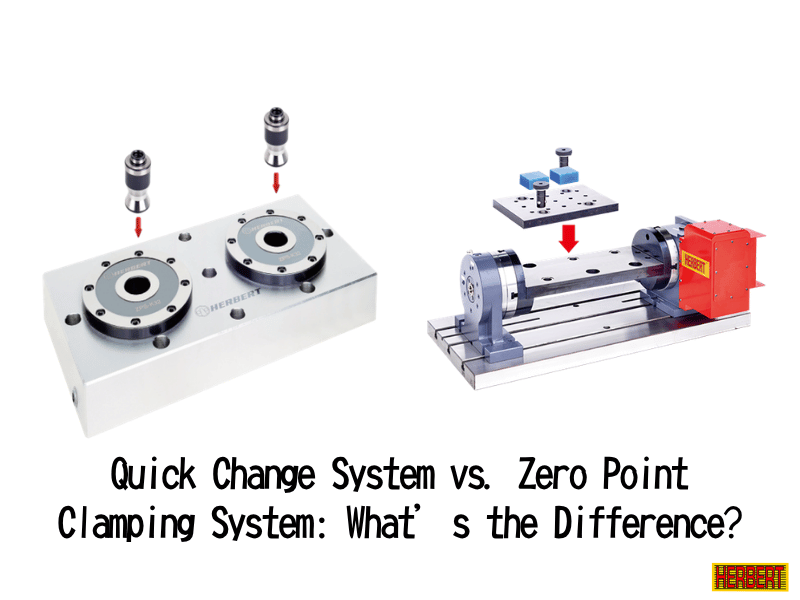
In modern CNC machining, efficiency and precision are no longer optional—they are essential. Manufacturers are constantly looking for ways to reduce setup time, improve repeatability, and increase machine utilization. Two commonly discussed solutions in this area are Quick Change Systems (QCS) and Zero Point Clamping Systems (ZPS).
Although these terms are often used interchangeably, they are not exactly the same. Understanding the difference between them can help manufacturers select the right solution for their production needs—and unlock the full potential of their CNC machines.
What Is a Quick Change System?
A Quick Change System is a complete workholding solution designed to minimize setup time when changing fixtures, pallets, or workpieces.
Its primary goal is simple:
Reduce machine downtime and speed up changeovers.
A typical Quick Change System includes a complete setup designed to streamline fixture changes, such as:
- Base plates for standardized mounting
- Fixture plates for different workpieces
- Pallet systems for batch processing
- Pull bolts for quick engagement
- Clamping modules (often zero point systems) for positioning and locking
By standardizing how fixtures are mounted on a machine table, QCS allows operators to swap setups quickly without complex manual adjustments.
At companies like Herbert Enterprise Co., Ltd., Quick Change Systems are engineered to support a wide range of CNC machines, helping manufacturers improve flexibility and productivity across different applications.
You can explore Herbert’s Quick Change System solutions here:
https://www.her-bert.com/en-US/plist15-quick-change-systems
What Is a Zero Point Clamping System?
A Zero Point Clamping System is a precision positioning technology used to ensure that fixtures or workpieces are always located at the exact same reference point—known as the “zero point.”
Its primary function is:
Deliver highly repeatable and accurate positioning.
A Zero Point Clamping System focuses specifically on precision positioning and repeatable clamping, typically consisting of:
- Zero point clamping modules (core positioning units)
- Pull bolts (clamping studs)
- Precision base interfaces
- Internal locking mechanisms for secure fixation
When engaged, the system automatically positions and clamps the fixture with high accuracy. This eliminates the need for manual alignment and re-measurement.
High-quality systems can achieve repeatability within a few microns, ensuring consistent machining results across multiple setups.
You can learn more about Herbert’s Zero Point Clamping Systems here:
https://www.her-bert.com/en-US/plist1-zero-point-clamping-system
The Key Difference: System vs. Core Mechanism
While both systems share similar components, the key difference lies in their purpose: a Quick Change System is a complete workflow solution, while a Zero Point Clamping System is the precision mechanism that ensures repeatable positioning.
| Aspect | Quick Change System | Zero Point Clamping System |
|---|---|---|
| Core concept | Complete system / solution | Core positioning technology |
| Main purpose | Reduce setup time | Ensure precise repeatability |
| Focus | Efficiency and flexibility | Accuracy and consistency |
| Components | Multiple modules, plates, and fixtures | Clamping modules, pull bolts, and locking units |
| Relationship | Often includes a Zero Point system | Often serves as the core of a QCS |
In simple terms:
- Quick Change System = Workflow efficiency
- Zero Point System = Precision positioning
How They Work Together
Rather than being competing technologies, these two systems actually complement each other.
A Zero Point Clamping System is often the foundation of a Quick Change System. When combined, they allow manufacturers to achieve both:
- Fast changeovers
- High precision
For example:
- Operators can prepare fixtures offline
- Install them on the machine within seconds
- Start machining immediately—without re-zeroing
This workflow significantly reduces setup time while maintaining consistent accuracy across multiple operations.
Why Manufacturers Use Both Systems
Modern production environments demand:
- High-mix, low-volume manufacturing
- Short lead times
- Minimal human error
- Automation compatibility
By integrating Quick Change Systems with Zero Point Clamping, manufacturers can:
1. Reduce Setup Time
Zero Point systems eliminate manual alignment, while QCS enables fast fixture swapping. Together, they can dramatically shorten setup procedures and improve machine uptime.
2. Improve Machining Accuracy
Repeatable positioning ensures that every setup is identical, reducing scrap, rework, and tolerance variation.
3. Increase Machine Utilization
Less downtime means more cutting time—and higher productivity.
4. Support Automation and Smart Manufacturing
These systems are ideal for robotic loading, palletized production, and other automated machining processes.
Applications Across CNC Machines
Both Quick Change Systems and Zero Point Clamping Systems are widely used across:
- CNC milling machines
- Vertical machining centers (VMC)
- Horizontal machining centers (HMC)
- CNC lathes
- 4-axis and 5-axis machining centers
- Rotary tables
- EDM machines
- Automated production lines
Their versatility makes them essential tools for industries such as aerospace, automotive, medical devices, and precision electronics.
The Herbert Solution
At Herbert Enterprise Co., Ltd., we provide both Quick Change Systems and Zero Point Clamping Systems as part of a complete workholding solution.
Our systems are designed to:
- Improve setup efficiency
- Ensure micron-level repeatability
- Support flexible and automated production
- Integrate seamlessly with various CNC machines
By combining both technologies, manufacturers can achieve faster changeovers without sacrificing precision.
Conclusion
Quick Change Systems and Zero Point Clamping Systems serve different but complementary roles in modern manufacturing.
- Quick Change Systems focus on speed and efficiency
- Zero Point Clamping Systems focus on precision and repeatability
When used together, they create a powerful solution that enables manufacturers to maximize productivity, reduce downtime, and maintain consistent quality.
For manufacturers looking to stay competitive in today’s fast-paced industry, adopting both systems is no longer just an upgrade—it is a strategic advantage.
Get Started with Herbert’s Workholding Solutions
Looking to reduce setup time and improve machining accuracy across your CNC operations? Herbert Enterprise Co., Ltd. offers a complete range of Quick Change Systems and Zero Point Clamping Systems designed to meet the demands of modern manufacturing.
Whether you are upgrading an existing machine or building a new production line, our team can help you find the right solution for your application.
Contact Herbert today to discuss your requirements and discover how our workholding systems can enhance your productivity, precision, and efficiency.