
What’s New
How Zero Point Clamping Systems Improve Precision in RF and Microwave Component Manufacturing
As wireless communication technologies continue to evolve, the demand for high-frequency RF and microwave components has grown rapidly. Industries such as 5G telecommunications, satellite communication, aerospace electronics, and radar systems rely heavily on these precision components to ensure stable signal transmission and high-performance connectivity.
Manufacturing these components, however, presents unique challenges. RF and microwave parts often feature complex geometries, tight tolerances, and intricate internal structures. Even minor deviations in machining accuracy can affect signal performance, making precision manufacturing essential.
To meet these requirements, many manufacturers have adopted Zero Point Clamping Systems as part of their machining workflow. By enabling fast fixture changes and highly repeatable positioning, these systems help improve production efficiency while maintaining exceptional precision.
The Precision Requirements of RF and Microwave Components
RF and microwave components are designed to transmit signals at extremely high frequencies. Because of this, their physical dimensions and surface quality directly influence electrical performance.
Typical components include:
- Waveguide housings
- Microwave filter blocks
- RF amplifier housings
- Antenna modules
- Satellite communication components
These parts are commonly manufactured from materials such as aluminum alloys, copper alloys, and other high-conductivity metals. During machining, manufacturers must maintain strict control over:
- Dimensional accuracy
- Surface finish quality
- Geometric consistency
- Alignment between multiple machining operations
In many cases, components require multi-sided machining or multiple setups, which makes accurate repositioning essential.
Challenges in Traditional Workholding
Traditional workholding methods often require manual alignment when fixtures or workpieces are reinstalled. For complex RF components, this process can create several challenges:
- Time-consuming setup procedures
- Increased risk of positioning errors
- Accumulated tolerance deviations across multiple setups
- Reduced machine utilization
When each setup requires manual re-zeroing or measurement adjustments, production efficiency drops significantly. In industries where precision and repeatability are critical, even small positioning errors can result in rejected parts or costly rework.
What Is a Zero Point Clamping System?
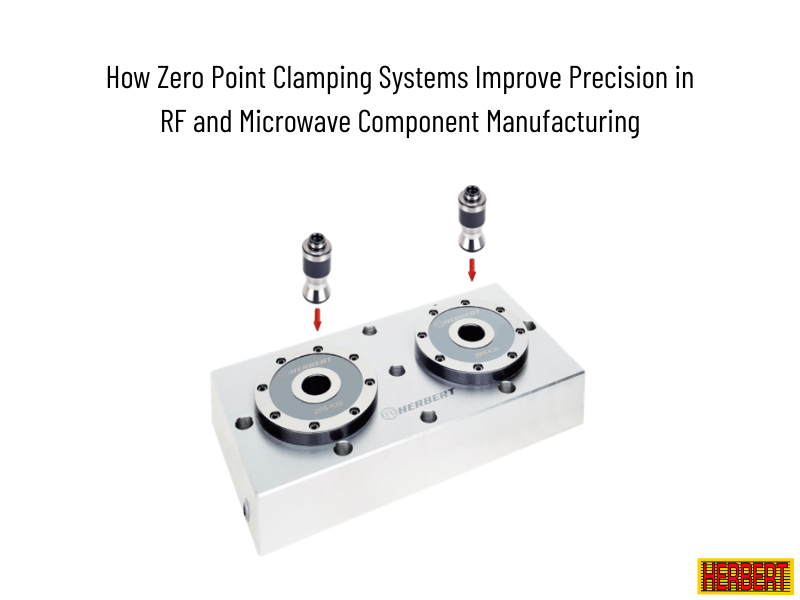
A Zero Point Clamping System is a modular workholding solution designed to establish a precise and repeatable reference point on a machine table. Once the reference point is established, fixtures or pallets equipped with pull bolts can be mounted and removed quickly while maintaining consistent positioning.
The system typically consists of:
- Zero point clamping modules
- Pull bolts
- Base plates or pallets
- Fixture plates
When the pull bolt engages with the clamping module, the system automatically locks the fixture into position. This ensures that the fixture returns to the exact same location every time it is installed.
This repeatability allows manufacturers to eliminate manual alignment procedures and dramatically reduce setup time.
Advantages for RF and Microwave Component Production
Improved Positioning Accuracy
Zero point clamping systems provide highly repeatable positioning, often within a few microns. This precision is essential for RF components where geometric accuracy directly impacts signal performance.
By maintaining consistent positioning across multiple setups, manufacturers can ensure that every machining operation aligns perfectly with previous processes.
Faster Setup and Changeover
RF component production often involves small batches and frequent design changes. Zero point clamping systems allow operators to switch fixtures quickly without extensive recalibration.
This reduces downtime and allows CNC machines to spend more time cutting parts instead of preparing setups.
Reduced Accumulated Tolerance
Complex RF parts frequently require machining from multiple sides. Without consistent positioning, each setup may introduce small deviations that accumulate over time.
Zero point clamping systems minimize this issue by ensuring that each setup returns to the same reference position, maintaining consistent accuracy throughout the entire machining process.
Increased Machine Utilization
By minimizing setup time and simplifying fixture installation, manufacturers can significantly increase machine utilization rates. CNC machines can move from one job to another more efficiently, improving overall production throughput.
This is particularly valuable for manufacturers producing high-value precision components.
Compatible with Advanced CNC Machining
RF and microwave components are commonly manufactured using advanced CNC equipment, including:
- CNC milling machines
- Vertical machining centers (VMC)
- Horizontal machining centers (HMC)
- 5-axis machining centers
- High-speed machining systems
Zero point clamping systems integrate easily with these machines, providing a standardized interface for fixtures and pallets.
For multi-axis machining, the consistent positioning provided by the system ensures accurate alignment between different machining orientations.
Supporting Flexible Manufacturing
Modern RF component manufacturers often operate in environments that require:
- Small-batch production
- Rapid prototyping
- High-mix manufacturing
- Fast product development cycles
Zero point clamping systems support these flexible production models by allowing manufacturers to change setups quickly while maintaining consistent machining accuracy.
When combined with modular fixtures and pallet systems, they can also support automated production cells and robotic loading systems.
Conclusion
The manufacturing of RF and microwave communication components requires an exceptional level of precision and efficiency. With complex geometries, tight tolerances, and multi-step machining processes, reliable workholding solutions are essential.
Zero point clamping systems provide a powerful solution by delivering precise, repeatable positioning while dramatically reducing setup time. For manufacturers producing high-frequency communication components, this technology helps maintain quality standards while improving productivity.
Companies like Herbert Enterprise Co., Ltd. continue to develop advanced workholding solutions that support modern CNC machining environments. By integrating zero point clamping systems into their production workflows, manufacturers can achieve greater efficiency, accuracy, and flexibility in RF and microwave component manufacturing.
Manufacturers seeking to improve machining performance and production efficiency are encouraged to explore advanced clamping solutions and consult with experienced workholding specialists to identify the most suitable system for their operations.