
What’s New
Rotary Table Applications in CNC Machining: Choosing Between Self-Centering and Hydraulic Vises
Introduction
In CNC machining, precision and efficiency are more than goals—they are requirements for success. Among the many accessories that enhance CNC capabilities, the rotary table stands out as a versatile solution that allows multi-axis machining, complex part geometries, and reduced setups. However, even the most advanced rotary table cannot perform to its full potential without the right workholding device. The vise you choose determines whether the workpiece is clamped securely, aligned accurately, and machined with consistency.
For manufacturers using rotary tables, two of the most effective workholding solutions are the Self-Centering Vise and the Hydraulic Vise. Both offer unique advantages depending on the type of machining and workpiece involved. This article explores rotary table applications in CNC machining and helps you understand how to choose between these two vise types.
Understanding Rotary Tables in CNC Machining
A rotary table is a precision device mounted on a CNC machine that allows the operator to rotate the workpiece around a fixed axis. This enables machining on multiple sides without needing to reposition the part manually. Rotary tables are often paired with 4-axis and 5-axis machining centers to:
- Reduce the number of setups by allowing continuous multi-face machining
- Improve accuracy by minimizing accumulated positioning errors
- Shorten production times by combining multiple processes into a single operation
Industries such as aerospace, automotive, mold-making, and medical device manufacturing rely heavily on rotary tables to achieve high-quality, complex parts in fewer cycles.
The Role of Workholding on Rotary Tables
While the rotary table provides positioning and flexibility, the vise ensures the part stays in place under cutting forces. Rotary tables present special challenges for workholding:
- Side forces and vibrations during cutting can shift the workpiece if clamping is insufficient.
- Complex geometries often require multi-face access, making traditional vices less effective.
- Precision requirements demand that the part returns to the exact position after indexing.
Selecting the right vise enhances the rotary table’s performance, ensures repeatability, and maximizes productivity.
Self-Centering Vise on Rotary Tables
The Self-Centering Vise is designed to automatically align the workpiece at the center of the vise. This makes it particularly well-suited for rotary table applications, where concentricity and repeatability are critical.
Key Features
- Automatic centering: Both jaws move symmetrically, ensuring the part is always positioned in the middle.
- Quick changeovers: Ideal for batch production or high-mix, low-volume operations.
- Compact design: Allows full tool access around the part during 4-axis or 5-axis machining.
Best Applications
- Round or symmetrical workpieces: Such as shafts, discs, or medical implants.
- Multi-face machining: Especially in aerospace or medical industries, where small errors can compromise safety.
- Frequent part changes: Perfect for job shops or prototyping environments where flexibility is key.
By reducing setup time and ensuring accuracy, self-centering vises make rotary tables more effective for complex, precision machining tasks.
Hydraulic Vise on Rotary Tables
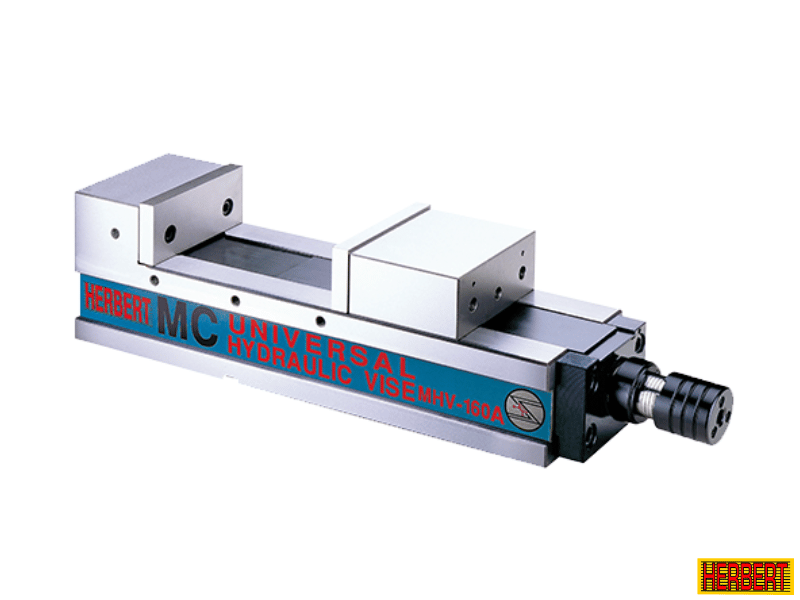
The Hydraulic Vise focuses on delivering maximum clamping power and stability, making it ideal for heavy-duty machining. With hydraulic actuation, operators can achieve consistent clamping force at the push of a button.
Key Features
- High clamping force: Maintains secure grip on large or heavy workpieces under intense cutting conditions.
- Consistency: Hydraulic pressure ensures uniform force every time, reducing variability.
- Durability: Built to withstand long production cycles and high-volume machining.
Best Applications
- Large or heavy parts: Such as automotive engine blocks or aerospace brackets.
- High cutting forces: Suited for hard metals like steel, titanium, or cast iron.
- Long production runs: Perfect for mass production where stability and repeatability are crucial.
Hydraulic vises are a natural fit for rotary tables when machining large, high-tolerance parts that demand absolute rigidity.
Choosing Between Self-Centering and Hydraulic Vises
The decision depends on your machining priorities:
| Factor | Self-Centering Vise | Hydraulic Vise |
|---|---|---|
| Setup Speed | Fast, with automatic centering | Moderate, requires hydraulic control |
| Clamping Force | Adequate for small to medium parts | Very high, ideal for large or heavy parts |
| Best For | Symmetrical, round, or multi-face parts | Large, heavy-duty, or long-cycle machining |
| Flexibility | Excellent for frequent part changes | Best for stable, repetitive production |
| Precision | High concentricity and repeatability | High stability under cutting forces |
In many production environments, manufacturers use both. Self-centering vises handle flexible jobs and smaller parts, while hydraulic vises manage heavy-duty tasks. Together, they allow the rotary table to perform across a wide spectrum of applications.
Conclusion
The rotary table transforms CNC machining by enabling multi-axis operations, reduced setups, and enhanced accuracy. But without the right vise, even the most advanced rotary table cannot deliver its full potential.
The Self-Centering Vise is the go-to choice for manufacturers who need flexibility, quick setups, and concentric accuracy. The Hydraulic Vise, on the other hand, is indispensable for heavy-duty machining that requires maximum clamping force and long-term stability.
At Herbert Enterprise Co., Ltd., we design and manufacture both Self-Centering Vises and Hydraulic Vises, providing manufacturers with the tools to unlock the full capabilities of CNC rotary tables. Whether your focus is precision, power, or flexibility, our solutions ensure that your machining processes are efficient, accurate, and reliable.