
What’s New
How Precision Grinding Vises Improve Surface Finish Accuracy
In precision machining, surface finish accuracy is one of the most critical indicators of product quality. Among all machining processes, grinding stands out for its ability to achieve micron-level surface smoothness and dimensional precision. However, such precision can only be realized when the workpiece is clamped with absolute stability. This is where a Precision Grinding Vise becomes indispensable — it ensures that the workpiece remains perfectly aligned and vibration-free throughout the grinding operation.
The Relationship Between Clamping Stability and Surface Finish
Grinding involves continuous contact between the workpiece and an abrasive wheel rotating at high speed. Even the slightest movement or vibration can produce chatter marks, waviness, or uneven surface texture. The key to preventing these issues lies in maintaining consistent clamping force and geometrical alignment.
A well-engineered precision vise offers the following advantages:
- High parallelism and squareness – Ensures the workpiece is held in perfect alignment with the grinding surface.
- High rigidity structure – Reduces deformation caused by cutting pressure or thermal expansion.
- Fine-tuned surface treatment – Precision grinding and hardening processes maintain dimensional integrity over years of use.
These features enable precision vises to minimize micro-vibration and displacement, allowing grinding machines to reach their full potential in producing smooth, uniform surfaces.
Material and Structural Engineering: The Foundation of Precision
Most high-end grinding vises are made of hardened tool steel that undergoes meticulous heat treatment and precision grinding. This combination delivers exceptional hardness, wear resistance, and long-term accuracy. In addition, the surfaces are carefully finished to achieve sub-micron flatness, ensuring stable contact with the workpiece and machine table.
Some models incorporate adjustable or double-clamping mechanisms that allow for variable workpiece dimensions or symmetrical clamping pressure distribution. This design not only prevents workpiece distortion but also improves clamping repeatability, especially in high-volume production environments.
MC Double Clamping Precision Vise: A Practical Example
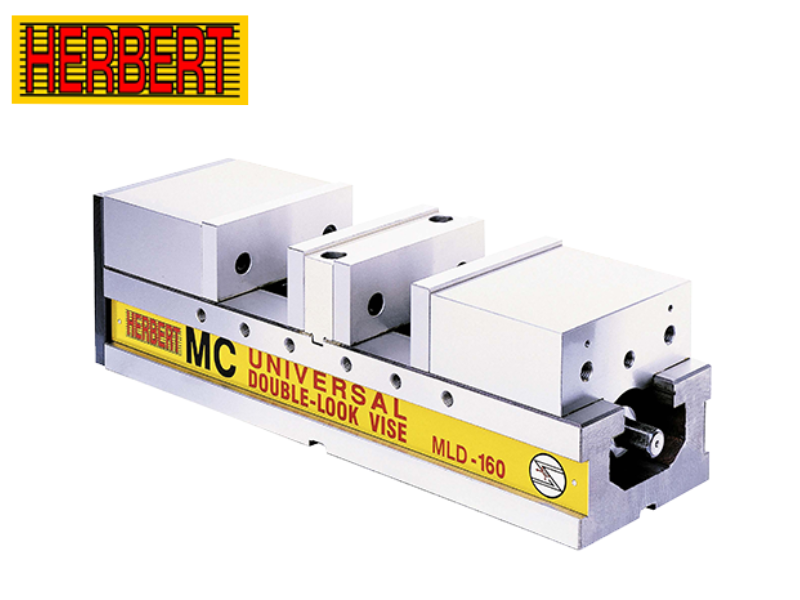
An excellent example of such engineering is the HERBERT MC Double Clamping Precision Vise. Designed for ultra-stable and efficient operations, this vise combines dual clamping capability with outstanding structural rigidity. Each vise can securely hold two workpieces simultaneously, optimizing machine utilization and shortening setup time.
Key performance advantages include:
- Double clamping design – Allows machining of two parts at once, improving throughput for toolroom and production lines.
- Precision ground surfaces – Guarantees perfect contact with the machine bed and workpiece.
- Hardened steel construction – Provides durability against high grinding forces and thermal cycles.
- High repeatability – Maintains consistent accuracy even under frequent clamping and unclamping cycles.
This makes the MC Double Clamping Precision Vise ideal for grinding, EDM, and high-precision milling operations where absolute rigidity and accuracy are essential. Its compact structure also minimizes interference, making it suitable for automation or multi-axis machining setups.
Precision in Every Micron: The Engineering Impact
Using a precision vise during grinding directly enhances surface finish quality by ensuring even pressure distribution across the workpiece. When the clamping faces are flat and parallel, the workpiece stays perfectly horizontal, allowing uniform material removal. As a result, the grinding wheel can achieve finer feed rates without sacrificing surface consistency.
In production lines that handle delicate or high-tolerance components — such as semiconductor parts, mold slides, or precision jigs — the improvement in surface finish not only reduces rework but also extends component lifespan and operational performance.
Applications Across Industries
Precision grinding vises, especially double-clamping models like the HERBERT MC series, are widely applied in:
- Semiconductor manufacturing – for precision flat surface finishing on ceramic and metallic components.
- Mold and die production – ensuring mirror-polished surfaces and perfect parting lines.
- Tool and jig making – for aligning and finishing complex precision fixtures.
- Automation systems – where multi-part clamping reduces setup time and increases cycle efficiency.
Conclusion
Surface finish accuracy depends as much on the machine as it does on the clamping system. A high-quality Precision Grinding Vise, such as the HERBERT MC Double Clamping Precision Vise, provides the rigidity, alignment, and repeatability necessary for flawless grinding results. By minimizing vibration and ensuring consistent parallelism, it enables manufacturers to achieve superior surface quality, shorter setup times, and greater overall productivity — making it an essential tool for every precision workshop.