
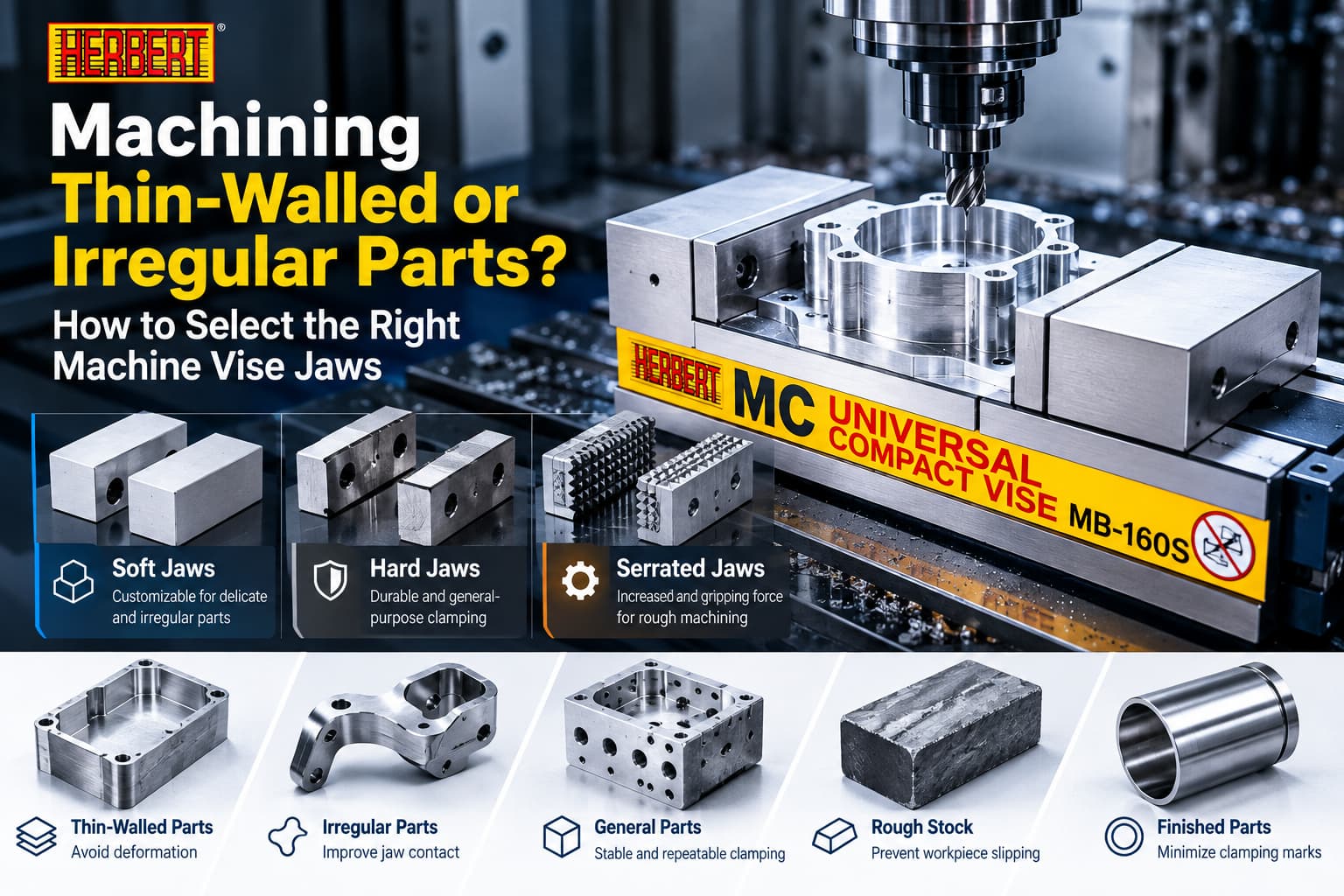
Thin-walled and irregularly shaped workpieces require more than strong clamping force. The wrong machine vise jaws can deform delicate components, leave unwanted marks, or allow parts to shift during CNC machining.
Soft jaws are often suitable when customized contact surfaces are needed, while hard jaws are generally preferred for durable, repeatable clamping of suitable workpiece surfaces. Serrated jaws may provide additional grip during rough machining, but can damage finished surfaces.
The best choice depends on workpiece material, geometry, contact area, cutting forces, and required tolerance. This guide explains how to select machine vise jaws for challenging workpieces and what to consider when matching jaw plates with a CNC machine vise.
1. Why Are Thin-Walled and Irregular Parts Difficult to Clamp?
Thin-walled and irregularly shaped parts create different workholding challenges.
Thin-walled components can deform when clamping pressure is concentrated on a small area. Irregular workpieces may have curved, angled, or uneven surfaces that do not contact standard flat jaws consistently.
Common machining problems include:
- Workpiece deformation: Excessive or uneven clamping pressure changes the part's shape.
- Insufficient contact: Flat jaws touch only a limited area of an irregular workpiece.
- Workpiece slipping: The available holding force is insufficient to resist cutting forces.
- Surface damage: Hard or serrated jaw surfaces leave marks on finished components.
- Inconsistent positioning: Workpieces do not return to the same location between machining cycles.
For example, a thin-walled aluminum housing may deform when clamped between standard jaws. Even if the part is machined to the correct dimensions while held, it may change shape after unclamping.
Similarly, a curved component held between flat jaws may contact only a few points, making its position less stable during milling.
Key takeaway: Reliable workholding depends on adequate support, suitable jaw contact, and controlled clamping force—not simply tightening the vise harder.
2. Soft Jaws vs. Hard Jaws: What Are the Key Differences?
Soft jaws and hard jaws serve different purposes in CNC machining.
Soft jaws are typically made from machinable materials, such as aluminum or low-carbon steel. They can be machined to create a contact profile that matches the workpiece.
Hard jaws are generally made from hardened steel or other wear-resistant materials. They provide durable clamping surfaces and are commonly used when repeated gripping and resistance to wear are important.
Serrated jaws feature teeth or textured contact surfaces designed to increase mechanical engagement with suitable workpieces, particularly where surface marking is acceptable.
Machine Vise Jaw Comparison
| Feature | Soft Jaws | Hard Jaws | Serrated Jaws |
|---|---|---|---|
| Typical Material | Aluminum or machinable steel | Hardened steel | Hardened steel |
| Contact Surface | Can be machined to fit the part | Usually fixed geometry | Toothed or textured |
| Main Advantage | Customized workpiece support | Durability and wear resistance | Increased mechanical grip |
| Surface Marking Risk | Often lower with suitable design | Depends on contact conditions | Generally higher |
| Suitable Applications | Delicate, thin-walled, or irregular parts | General-purpose and repetitive clamping | Rough stock and suitable heavy-cutting applications |
| Main Limitation | Wear and possible need for remachining | Limited conformity to unusual shapes | May damage finished surfaces |
No single vise jaw type provides the highest machining accuracy in every situation.
A properly designed soft jaw may improve support for a complex workpiece, while a suitable hard jaw can provide consistent clamping for regular-shaped components.
The deciding factor is how effectively the jaw supports and locates the specific workpiece.
Related Reading: For a more detailed overview of specialized jaw configurations, read HERBERT's 5 Types of Jaws for Self-Centering Vises: How to Choose the Right One for Your Application . This guide explains additional jaw options for self-centering vise applications.
3. When Should You Use Soft Jaws for Thin-Walled Parts?
Soft jaws are often worth considering when standard hard jaws create concentrated contact pressure or cannot adequately support the workpiece geometry.
Because machinable soft jaws can be customized, operators may create pockets, steps, or profiles that fit the component's shape.
This can provide more suitable contact and support, although the result depends on jaw design and machining conditions.
Application: Thin-Walled Aluminum Housings
Consider a thin-walled aluminum housing that must undergo finish milling.
If the housing is clamped between standard flat jaws, pressure may concentrate on two narrow contact areas. Increasing clamping force can make the distortion worse.
A properly designed soft jaw may help by:
- Supporting a larger portion of the workpiece
- Distributing clamping pressure more appropriately
- Providing a repeatable locating profile
- Reducing the need for excessive clamping force
- Improving access to selected machining features
However, soft jaws do not automatically prevent deformation. A thin-walled component can still distort if the jaw profile, support arrangement, or clamping force is unsuitable.
When Soft Jaws May Be Appropriate
Soft jaws are particularly useful when the application involves:
- Thin-walled components requiring distributed support
- Irregular profiles that need custom contact surfaces
- Finished surfaces that require careful handling
- Repetitive machining of parts with the same complex geometry
Before using soft jaws, confirm that the material and jaw design can withstand the expected cutting loads.
For thin-wall machining, jaw design should also be evaluated alongside cutting strategy, workpiece support, and clamping force.
Related Reading: Workpiece seating is another important factor in machining accuracy. If a part lifts away from its locating surface during clamping, even an otherwise stable setup can produce dimensional errors. Learn more in How to Eliminate Workpiece Lifting in CNC Machining: A Guide to the HER-BERT VCP Series MC Vise .
4. When Are Hard Jaws or Serrated Jaws More Suitable?
Hard jaws are commonly used when the workpiece has suitable clamping surfaces and the operation requires durable, wear-resistant jaw contact.
They are often appropriate for general CNC milling applications involving regularly shaped components.
Application: Repetitive Machining of Steel Blocks
Consider a production line machining rectangular steel blanks.
If each workpiece has consistent dimensions and suitable reference surfaces, hardened flat jaws may provide a practical solution without requiring custom jaw machining.
Potential advantages include:
- Durable contact surfaces
- Resistance to wear during repeated use
- Consistent jaw geometry when properly maintained
- Reduced need for application-specific jaw preparation
Application: Rough Machining of Irregular Stock
For rough stock with uneven surfaces, standard smooth jaws may not provide sufficient resistance to slipping.
Serrated jaws can increase mechanical grip by engaging the workpiece surface.
They may be suitable when:
- The workpiece has an unfinished clamping surface
- Surface marking is acceptable
- Cutting loads require additional resistance to movement
- The material and geometry can tolerate localized gripping pressure
However, serrated jaws should not automatically be selected for every irregular workpiece.
Their teeth can leave marks or introduce localized stress, and they may be unsuitable for thin walls or finished surfaces.
Selection tip: Choose hard or serrated jaws when their contact geometry, gripping characteristics, and potential surface effects are appropriate for the operation.
5. How to Select Machine Vise Jaws Based on Workpiece Shape and Material
The most useful way to choose machine vise jaws is to evaluate the actual workpiece and machining requirements together.
Quick Selection Guide
| Workpiece or Machining Condition | Common Problem | Jaw Type to Consider | Important Consideration |
|---|---|---|---|
| Thin-walled aluminum housing | Clamping deformation | Custom-machined soft jaws | Support the walls and control clamping force |
| Irregular-shaped component | Limited jaw contact | Profiled soft jaws | Match the locating and contact surfaces |
| Rectangular steel block | Repetitive clamping | Hard flat jaws | Verify jaw condition and positioning |
| Rough steel blank | Slipping during rough machining | Serrated jaws | Confirm that surface marking is acceptable |
| Finished precision component | Scratches or clamping marks | Suitable soft jaws or protective contact arrangement | Verify surface condition and holding stability |
| Cylindrical workpiece | Unstable contact with flat jaws | Compatible V-jaws or profiled jaws | Prevent rotation and confirm locating accuracy |
These are general engineering guidelines, not guaranteed results. Actual jaw selection must account for the complete workholding setup.
Five Questions to Ask Before Choosing Vise Jaws
1. What material is being machined?
Material hardness, strength, surface finish, and susceptibility to deformation influence jaw selection.
2. Is the workpiece thin-walled or easily distorted?
Thin sections may require distributed support and carefully controlled clamping force.
3. Does the workpiece have reliable locating surfaces?
An irregular shape may require customized jaws, additional supports, or a dedicated fixture.
4. How much cutting force will the operation generate?
Rough milling and finish milling can place different demands on the workholding arrangement.
5. Must the jaw preserve a finished surface?
If clamping marks are unacceptable, jaw material, contact geometry, and surface cleanliness become particularly important.
For difficult applications, it may be necessary to adjust both the jaw configuration and machining strategy rather than relying on jaw replacement alone.
6. Choosing Compatible Vise Jaws and Workholding Solutions from HERBERT
After identifying the required jaw characteristics, the next step is confirming compatibility with the machine vise.
Jaw plates are not universally interchangeable. Their mounting dimensions, fastening arrangement, geometry, and intended vise series must match the equipment.
HERBERT offers machine vise and jaw plate product categories that manufacturers can review when planning a workholding setup.
HERBERT Jaw Plates
HERBERT's Jaw Plates category includes VSP/VCP Jaw Plates and Special Application Jaw Plates for different workholding configurations.
Buyers should confirm the required jaw design, mounting dimensions, and compatibility with the intended vise model before ordering.
HERBERT MC Mechanical Vises
For manufacturers evaluating a complete workholding setup, HERBERT also provides the MC Mechanical Vise (Machine Vise) product series.
When selecting a vise and jaw arrangement, manufacturers should verify:
- Vise model and jaw mounting dimensions
- Workpiece size and required opening capacity
- Available jaw configurations
- Required clamping force and workpiece support
- Machining access and cutting conditions
Important: The presence of a jaw plate category does not mean every soft jaw, hard jaw, or serrated jaw design is available for every HERBERT vise. Compatibility and customization options should be confirmed for the specific model.
7. FAQ: Machine Vise Jaws for Thin-Walled and Irregular Workpieces
Are soft jaws better than hard jaws for thin-walled parts?
Soft jaws are often preferable when custom-machined contact surfaces can provide more suitable support and reduce concentrated clamping pressure. However, their effectiveness depends on the jaw profile, workpiece geometry, clamping force, and machining conditions.
Can soft jaws improve CNC machining accuracy?
Soft jaws can improve positioning consistency and workpiece support when correctly machined and installed. They do not automatically improve machine accuracy or eliminate errors caused by tooling, thermal effects, or other process conditions.
Can hard jaws damage aluminum workpieces?
Yes. Hard jaws can leave marks or deform aluminum components if the contact area or clamping force is unsuitable. However, damage is not inevitable; it depends on the jaw surface, workpiece condition, and setup.
Are serrated jaws suitable for irregular workpieces?
Serrated jaws may improve grip on suitable rough or unfinished surfaces. They are not necessarily appropriate for every irregular shape, particularly thin-walled or finished components that could be damaged by localized contact.
Can soft jaws be reused?
Yes, provided the jaw material, contact geometry, mounting features, and remaining dimensions are still suitable. Some soft jaws can be remachined, but their usable life depends on wear and the amount of material remaining.
Can any machine vise use soft jaws?
No. Soft jaw compatibility depends on the vise's jaw mounting design and dimensions. Always confirm the intended jaw plate or custom jaw arrangement for the specific vise model.
Conclusion: Choose the Jaw That Supports the Workpiece, Not Just the Strongest Grip
Selecting machine vise jaws for thin-walled or irregular parts requires balancing clamping stability, workpiece support, surface protection, and machining access.
Soft jaws can be useful when customized contact surfaces are needed. Hard jaws offer durable contact for suitable workpieces, while serrated jaws may provide additional grip when surface marking is acceptable.
The most effective choice is not always the hardest jaw or the highest clamping force. It is the jaw configuration that locates and supports the workpiece reliably throughout machining.
Need Help Selecting the Right Machine Vise Jaws?
HERBERT Enterprise Co., Ltd. provides machine vise and jaw plate solutions for different CNC workholding requirements.
Explore our Jaw Plates and MC Mechanical Vise product ranges to learn more about available options. Contact HERBERT to discuss your workpiece geometry, machining conditions, and jaw compatibility requirements.